Showing posts with label go green. Show all posts

Wednesday, June 16, 2010

One Green Thing: Living Without a Car

My car broke down (again) last Monday (June 7), and we're not planning to get it fixed or replace it anytime soon. We've been wanting to try living without a car for a month, but we always had a car as a backup and opted to use it more often than not when things got difficult. Well, now we have no choice so we'll give this a real go.

This will mean LOTS of adjustments:
  • Bike to work more often or take the bus. Trust me, biking is better -- and usually faster -- than the bus; not to mention that it's also cheaper and healthier. On the other hand, I can be productive while on the bus (aka read a book, answer email, etc). But biking to work doubles as exercise, so it's a draw. Although biking has a slight edge because I control the timetable instead of being at the mercy of when the bus comes.
  • Buy a trailer for the bike for when we need to haul stuff, such as the water cooler to the track workouts or camping gear.
  • Take the train when we go visit Jason's parents in South Florida, and bring our bikes to get from the station to their house and around town while there. I am actually looking forward to this. It's been years since I've been on a train.
  • Adjust our sleep schedule so we have enough time for other exercise (running, yoga, etc) before we bike or bus to work. This means going to bed earlier and waking up much earlier some days.
  • Explore other options from this wikiHow article: http://www.wikihow.com/Live-Without-a-Car
  • Another great resource is http://www.bikesatwork.com/carfree/
  • Keep track of all our transportation and related expenses, and document how we overcome the challenges we face along the way. 
Life without a Car Diary

We've been at this for a week, and plan to stick with it at least through July 15th to get a snapshot of what it would take to do this full time in Orlando. We've already faced and overcome a few challenges. Here's a summary of how we've dealt with not having a car each day so far:

  • Monday 6/7: Car died after work. We used Geico's roadside assistance to get it towed home and got a ride in the tow truck.
  • Tuesday 6/8:  Took the day off from work to figure out what was wrong with the car. Jason biked to the auto parts store a few times, and I biked to Publix for some groceries. These were all short trips of less than 2 miles each. Jason researched buying a TDI.
  • Wednesday 6/9: Biked to work (15 miles each way), which we've done several times before and used to do on a regular basis. This is the day we decided not to look for a new car and try living without one for a month.
  • Thursday 6/10: This is my track workout day, so I biked 4.5 miles there, ran 2.5 miles, then biked 11 more miles to work. It wasn't as bad as I expected. Jason biked to the coop to pick up our produce on his way home.
  • Friday 6/11: Since we had a triathlon on Saturday, we took a break from biking and rode the bus to work. We attempted to take an earlier bus on a different route, but it never came, so we went to our usual route a half hour later. We still made it to work with plenty of time to spare.
  • Saturday 6/12: Our first and biggest concerned when the car broke down was how we'd make it to the triathlon in Clermont. My dad came to the rescue and lent us his truck, which meant him and my mom had to drive to our apartment in separate cars to drop it off Friday night.
  • Sunday 6/13: Jason rode his bike to run some errands in the morning (get some cash and buy produce at the farmer's market). We drove the truck to my parents' house and spent the afternoon visiting with them and my gorgeous niece. My dad was going to give us a ride back, but we opted to take the bus home to see how long it would take since we'll have to go back there next Sunday for father's day. The ride went well and I got some reading done. Since it was really hot, and we were running a tad late, my mom gave us a ride to the bus station 1.25 miles away (well actually, the 7-11 across the street so we could get a slurpee and then walk to the bus station).
  • Monday 6/14: We biked to work, both ways. It was ridiculously hot and humid! Jason rode ahead to ride to the bike shop since his bike was acting up. I did some yoga when I got home, after taking a cool shower, to help ease my tired muscles.
  • Tuesday 6/15: I woke up at 4 am, biked 4.5 miles to run, ran 4 miles, then biked another 11 miles to work. All this activity, and the early woke up, started catching up to me and I was exhausted most of the day. I feared I'd get stuck in the rain on the ride home, but it turned out to be really pleasant since it had just rained so it wasn't hot. I came home, showered, did some yoga, then proceeded to be grumpy the rest of the night. I went to bed early and vowed to sleep in the next day. 
  • Wednesday 6/16: The yoga and extra sleep helped, and I felt much better this morning. I sorta slept in until 6 am, did a 20 minutes of Yoga Meditative Flow, then rode the bus to work. Knowing that I have a track workout tomorrow, I thought it best to take it easy today and recover. Jason biked to the pool, but it was closed, so he biked to work early. It looked nasty out this afternoon, so a coworker gave us and his bike a ride home. 
Thoughts So Far ...

We thought we could bike to work 4 days a week, and take the bus on Fridays as a rest day before my long runs Saturday mornings. We're now reconsidering that and may ride the bus at least 2 times a week. If biking to work was our only form of exercise, and we weren't training for endurance races (me several  marathons and Jason a Half IM), we could probably bike to work 4-5 times a week. However, the extra exercise, plus the distance of the commute, plus waking up so early 3 times a week, plus the insane heat and humidity on the ride home, is a bit much for me.

Maybe I'd get used to it eventually, but for now I think I'll bike to work on Monday and Tuesday, ride the bus on Wednesday, bike Thursdays (maybe), then ride the bus on Friday. This is all subject to change on a daily basis depending on the weather and how my body feels. One thing is for sure, I'll need to be more diligent about doing yoga or my legs may revolt. I'll keep you posted on how my thoughts change as the month progresses, but I'm not ready to throw in the towel yet and I'm actually excited for the possibility of making this work on a permanent basis.

Wednesday, May 12, 2010

One Green Thing: Air Travel

We flew to San Francisco today, and I have to admit that the thought of green travel didn't even cross my mind when we planned this trip. It seemed like the perfect topic for today's blog post, so I sat in the airport in Dallas during my lay over researching it. I know it's a little late now, but maybe I can apply some of what I learn to the return trip, or be pleasantly surprised at what we may have already done without trying.

As a general rule, flying is not very green because of the huge amount of carbon emissions planes produce. However, there are a few things we can do to reduce the impact on the environment. I'm going to use this article from Planet Green, 5 Ways to Green Your Flight, as a guide for the rest of this post.

Book a Direct Flight

You don't have to tell me twice! I would obviously opt for a direct flight when available for a reasonable price, but now I have another reason to make this a priority next time. I had no idea that about 50% of the carbon emissions released by airplanes come from the takeoff and the landing. So having a lay over on your flight increases the impact significantly, not to mention the extra fuel burnt while idling on the runway. Our flight had one stop in Dallas, Texas. I didn't book the flights, so I am not sure if a non-stop flight was an option. We often can't control this, but I'm going to look into all the extra costs (both financially and environmentally) of both options the next time I book a flight.

Choose a Green Airline

We flew on American Airlines, who has apparently just introduced 76 new greener jets to their fleet that get about 28% better gas millage than their older jets. I don't think that we flew in one of these planes, but it's good to know they are taking a step in the right direction. We also had e-tickets, although we still got a printed boarding pass upon check-in. It would be nice if it was completely paperless -- letting me check-in online and pull up the boarding pass on my iPhone to get scanned at the gate.

Buy Carbon Offsets

I didn't even know this was an option, but I'm looking into it and will certainly be buying my share to offset this flight as well as the impact of our car. The idea is that you calculate the carbon emissions produce during your flight and pay that money to fund a project that reduces greenhouse gases. I'm still doing a lot of research on this, and will likely write a future post about it, but I was astonished to learned that 1 flight can produce more emissions than a car does for an entire year. Of course, driving to San Francisco would not have been feasible or practical, but we can still do our part to offset our impact.

Don't Use the Airplane Bathroom

I had no idea this had such an impact, consuming about six miles worth of fuel. I never look forward to using these anyway, and when you have to go you have to go, but I'll be more mindful of going before I board from now on.

Pack Less

We packed one big bag for the both of us that weighed 53 lbs, and we each have a carry-on backpack. Despite our best efforts, I think we could have packed less. I have to admit, I think I packed more workout clothes/gear than every day clothes because weather is unpredictable. I initially packed even more than I brought, but I managed to downsize some at the last minute. I never thought traveling as a runner would prove to be more complicated, but I'll learn efficiencies and streamline it as I travel now.

Additional Tips (of things we tried): 

  • go paperless as much as possible: e-ticket, phone receipt, etc.
  • bring an empty water bottle in the carry-on, and fill it at a water fountain after going through security instead of buying overpriced drinks on the plane and contributing to the use and waste of plastic cups
  • pack snacks to eat on the plane and at destination instead of buying overpriced and unhealthy food at the airport/plane
  • go grocery shopping at destination and cook instead of eating out -- this may not always be possible if there is no access to a kitchen, but even keeping healthy snacks around can help.
  • walk, rent a bicycle, or take the bus for transportation instead of driving
  • plan ahead to reduce spending on one-use items

Resources

Wednesday, May 5, 2010

One Green Thing: Bags

Using reusable bags, instead of paper or plastic, is the easiest green thing for me to do, the first change I remember making, and the one I do most consistently. I have at least a dozen reusable bags, and I am not exaggerating. I haven't counted, so it is quite possible that I have a lot more than that.

I started my collection with the Organic EcoSystem For One from ECOBAGS and slowly expanded from there. I bought a few at Publix, extra produce bags and a wrap-n-mat from reusablebags, and I get a free tote bag every time I make a big purchase at Running Warehouse. I also have a few tote and drawstring bag I've gotten at races. I use my bags for everything, from any kind of shopping, to carrying my lunch to work, to carrying my clothes/gear to the gym. I even have a pannier tote bag for my bike. I plan to use smaller reusable bags (that I'll either purchase or sew myself) in lieu of wrapping paper or gift bags this year.

With a few exceptions, for which I am currently researching alternatives (e.g. ziplock bags), I use very few plastic bags. Since I have so many tote bags, it's easy to leave a big supply in the car so I don't forget for the next trip to Publix, Target, or the Farmer's Market. On the occasion when I do forget, I'll simply carry the item home without a bag, ask for paper bags (which I use to carry the excess cardboard recycling), or use the plastic bags for trash in our small garbage cans at home. If you still have an excess of plastic bags, here are 99 Reuses for Plastic Bags.

Below is a list of my favorite products and sites to buy them. How about you, what are your favorite products to reduce the amount of plastic you use on a daily basis?

  • produce bags - great alternative to those thin plastic bags at the produce section; I also use them to carry all kinds of other small stuff, such as my workout accessories.
  • wrap-n-mat - clever alternative to snack plastic bags, and it doubles as a placemat. 
  • pannier tote bag - the perfect way to carry stuff when I bike to work, or for a trip to the farmer's market. It's easy to install and it fits a LOT.
  • reusablebags.com - this site has a huge selection of bags for shopping, carrying your lunch, packing a sandwich or a snack, and water bottles
  • ecobags.com - an alternate site to reusablebags.com
  • Or you can make your own: 13 Ways to Make Cool Reusable Shopping Bags for Free
Further Reading

Wednesday, April 28, 2010

One Green Thing: Laundry

I'm going to try something a little different today (which I may adopt for future posts as it gives me a good framework for drafting the posts). Below are the Top 10 Green Laundry Tips (check out full article for details on each item) from Planet Green's article,  How to Go Green: Laundry. I'll write how my own habits stack up to these tips, and where I can still improve.


1. Wear it more than once
Most of the clothes that I wear to work -- specially pants -- barely get dirty, so I try to hang them up when I get home and wear them again later in the week. We usually only do laundry on the weekends, so we'll hand wash our workout clothes while we shower and hang them to dry, then wash those that need it on the weekends. Of course, if something gets a stain or really dirty we'll toss it in the hamper immediately. Another reason for at least rinsing our workout clothes and hang drying them, is that tossing damp sweaty clothes in the hamper will just contaminate the rest of the laundry and may harvest bacteria.

2. Use green laundry detergent
Here is where I need the most work. I still buy Publix generic detergent, but I plan to look into greener alternatives. However, I do use white vinegar instead of fabric softener, and make sure to only use as much detergent as I need and not fill the cup all the way. The package instructions usually encourage you to use more than needed so you run out sooner and spend more on their product.

3. Choose concentrated detergent
The Publix generic detergent I buy is at least concentrated, which is another reason I do not need to use as much of it.

4. Make your own laundry detergent
I've been meaning to do this, but have yet to give a try. If you are interested in trying it, check out this great detailed visual guide at The Simple Dollar or check out the video.

5. Maximize your washer for energy efficiency
I always wash clothes in cold water, and wait until I have a full load to run the wash -- especially since I live in an apartment and have to pay per load.

6. Hang it out to dry
When we lived in the house, we put up a clothes line and I loved using it. Now that we live in an apartment, we do not have as much room to hang clothes, but we still do what we can. We have a clothes rack from Ikea, and I usually hang dry at least all my workout clothes (those tech fabrics are expensive, so I want to make them last as long as possible). We also hang dry workout clothes in the shower when we hang wash them after workouts between laundry days.

7. Maximize your dryer
I ditched dryer sheets long ago in favor of dryer balls. The vinegar in the wash ensure they are soft and clean-smelling, and the dryer balls seem to help with drying. Because sometimes I wash workout clothes with other clothes, the dryer is not always full but it doesn't tend to dry as well when it is too full anyway. Since I wash clothes in cold water anyway, I'm going to try to do an entire load of just workout clothes that I can hang dry to save myself one drying cycle.

8. Don't iron if you don't have to
No protests here! I hate ironing and rarely do it. In fact, I do not even know where our iron is (we do own one, but do not know why). We try to hang our clothes as soon as they come out of the dryer and rarely need to worry about ironing them.

9. Head to the laundromat
Technically, we have a laundromat at our apartment, but it is only 1 washer and dryer that services 4 apartments. It would probably be quicker to take all my clothes to the laundromat and wash/dry them at once, but I like multitasking while doing laundry and then I would not be able to hang dry some of the clothes.

10. Don't bother with dry cleaning
I don't really own many clothes that need dry cleaning, so I either use the washing machine or hand wash everything. The one thing I occasionally dry clean is my winter coat.

So, how do your own habits stack up? Is there anything new you plan to implement?

Resources:

Wednesday, April 21, 2010

One Green Thing: Water Bottles

I drink nothing but water on a daily basis, and I have a Klean Kanteen with insulating tote and sling that I refill with filtered tap water and carry everywhere I go instead of buying bottled water. It's become a second purse.

Bottled water is not only absurdly overpriced for something we already pay for at home, but it's not very environmentally friendly, nor is it really any safer than tap water in most cities. There is a lot of waste and cost associated with the production and transport of bottled water. Take a look at the video below, The Story of Bottled Water, for an eye opening look at the evolution of and waste created by the bottled water boom.


I am by no means perfect, and occasionally will consume bottled water when I have no other option, but I make every attempt to recycle that bottle even if I have to bring it home to do it. We have a reverse osmosis filter at home, which we use to refill our water bottles and make water for the fish tank, but I am appalled at the amount of water waste it produces. I wish we lived in a house so we could have a way to catch the waste water and use it to water the plants and such. 

For more information, check out the articles at http://planetgreen.discovery.com/bottled-water/

If you need your own reusable bottle, here are some options:
  • Klean Kanteen - stainless steel with optional insulating totes and slings
  • HydraPouch - alternative to paper cups during a road race
  • Vapur - the anti-bottle, made of ultra-durable BPA-Free polymer; stands when full - rolls, folds or flattens when empty

Wednesday, April 14, 2010

One Green Thing: Vegetarian Diet

In addition to living by candlelight during the month of April, we're also not eating any meat this month. I have to admit that my main motivation for not eating meat is not about being green, although that is a nice bonus. I'll tackle eating green in general in a different post, but here is a relevant excerpt from Planet Green's Top Green Eating Tips that talks about why easing up on meat is green:
Ease up on the meat
Meat is the most resource-intensive food on the table and eating less of it can be the single most green move a person makes. Producing meat requires huge amounts of water, grain, land, and other inputs including hormones and antibiotics, and leads to pollution of soil, air, and water. A pound of beef requires around 12,000 gallons of water to produce, compared to 60 gallons for a pound of potatoes. If you’re a meat eater, for starters, try cutting out a serving of meat each week.
So why are we not eating meat this month? We've tried this before and always ended up coming back to meat, or at least fish, once a week or more. We reduced the amount of meat we consumed for a while, and I actually lost the taste for steak, but lately we've been going back to our old ways and eating chicken, pork, and event steak regularly. It just becomes easier to grill some meat and steam some vegetables and call it a night. This makes for very boring meals of the same stuff week after week. We've been meaning to give this a real shot for a while--it's even on my 101 things list--then Jason watched Food, Inc. and didn't want to eat meat for a while, so no better time like the present.

It's been almost 2 weeks of eating only vegetarian meals, and I don't miss meat at all. At the beginning of the month, I said we'd eat fish if we had to, but we haven't feel the need yet. So what's different this time? I like beans now! lol My biggest hurdle before was getting enough protein to sustain my level of activity. Since I did not like beans, and don't care much for tofu, my options were very limited. There is only so much pasta and stir fry I can eat. But now with the addition of beans and grains, such as the amazing quinoa, the possibilities are endless.

Another hurdle was all the extra planning that cooking vegetarian meals would entail since I didn't know enough to just throw something together. Not being familiar with many of these ingredients, it was difficult to know if I'd like a recipe and I hate wasting cooking time on something I won't like. Well, I convinced Jason to be the cook for this month too, so that solved the problem. He is way more patient and willing to take risk than I am, so I'm ok with letting him experiment for the month. I stocked up on canned soups just in case he made something I really didn't like, but I have not needed to resort to that yet. Oh yeah, I like soups now too.

So if I'm not doing this to be green, what do I hope to get out of it? For me, this is an experiment in variety. It's allowing us to explore some new foods we wouldn't otherwise try, and I've got to say that our diet has seen more variety these past 2 weeks than I usually get all year! lol Here's some of the delicious meals we've tried so far:
I'm not sure if we'll eat vegetarian forever, but I can certainly see this extending well past April. If we do add back meat, it will be only occasionally, mostly chicken and fish, and we'll make better choices about where they come from.

Resources:

Friday, April 9, 2010

Friday Five: Why Go Green

There are many benefits to going green. Planet Green has an excellent article, Why Go Green?,  talking about the big picture, including Top 10 Tips and By the Numbers for those of you who like statistics. Below is my top five list of the benefits of going green. I find that at least one, and usually all, of these are true of every green thing I do.
  1. reduce impact on the environment - this is the main benefit of going green. Everything we do affects our planet and we're slowly using up all our natural resources. The Story of Stuff is a great look at this.
  2. incidental exercise - biking to work or walking to the store not only saves you money on gas and helps reduce pollution caused from car emissions (such as carbon dioxide) they are a great workout!
  3. reduce waste - recycling, or better yet reusing, keeps excess waste out of landfills. Sadly, not everything we recycle stays out of landfills so being mindful of the packaging and reusability of the things we purchase goes a long way. 
  4. eat healthier - eating green is healthier for us because they are natural and unprocessed, keeping more of their nutrients, which also means they require less resources and money to produce and transport them. e.g. most processed foods have extra sodium to help preserve the food longer; restaurants also use a lot of added sodium and fat (e.g. butter) to make things taste better even if they are not of the best quality from the start.
  5. save money - most things that we do to conserve the earth's resources also help us save money, e.g. tap water vs bottled water; biking vs driving; opening windows vs light bulbs or A/C; cooking vs eating at a restaurant.
How about you? Why do you go green?

Wednesday, April 7, 2010

One Green Thing: Candlelight

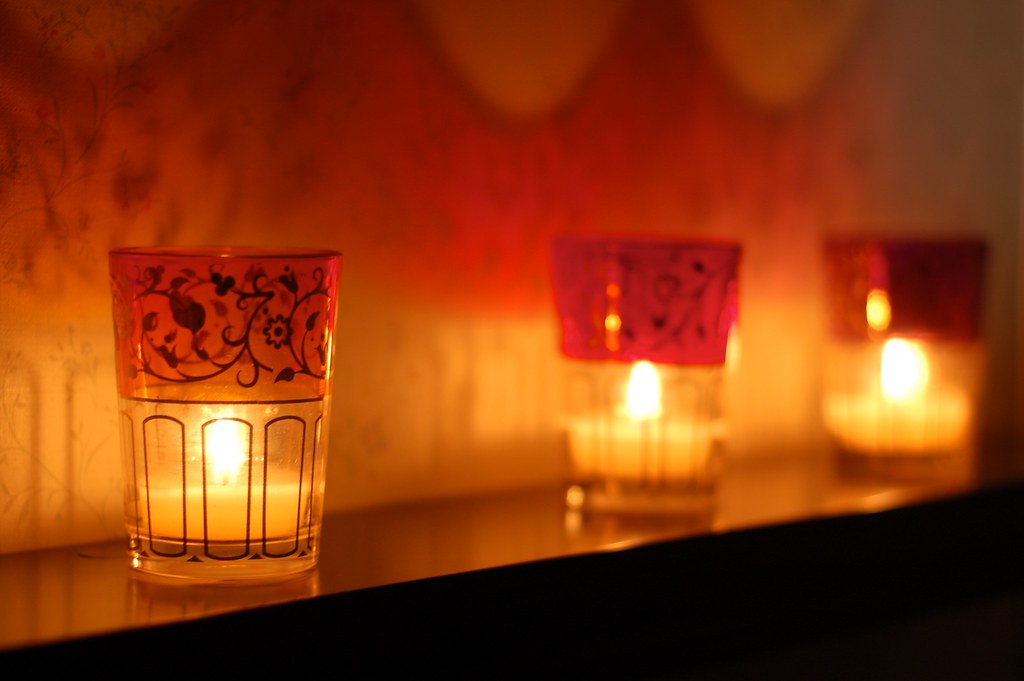
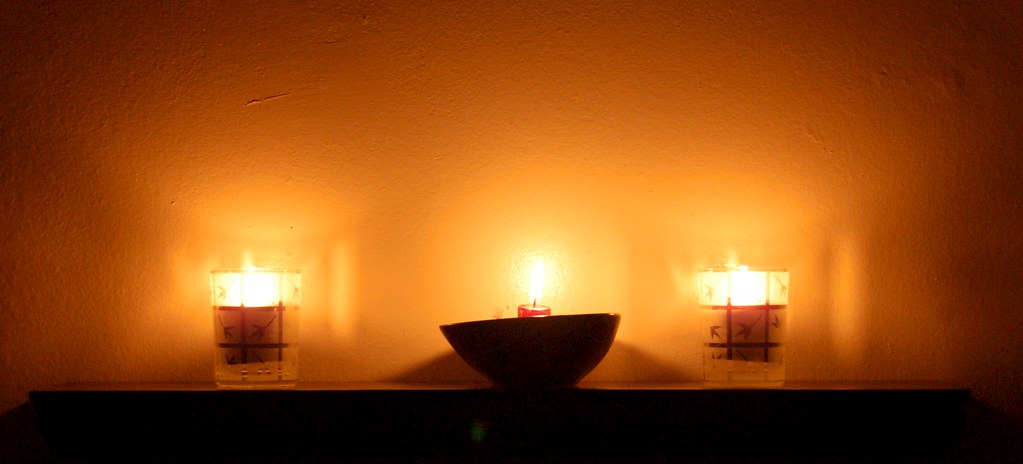
Earth Hour inspired us to shut off the lights and live by candlelight for the month of April. The verdict is still out about how much cheaper or better for the environment this may be than compact florescent light bulbs, but Jason will be posting a full analysis at the end of the month.

We long ago switched to compact florescent light bulbs to conserve energy, but we still flipped the switch and left lights on far more often than needed. I always try to turn off lights after I leave the room, but sometimes we forget. Flipping that switch became such a habit that we often had lights on in the middle of the day! There is no reason at all for that. To avoid temptation, and believe me it abounds, we put taped over all the light switches. I am hoping this experiment will help us realize just how little artificial light we need on any given day and help us adjust to do more things during daylight hours.

How has this changed my lifestyle so far:
  • We open windows and blinds more often to let in natural light; this further reduces our cost and impact on the environment because we need to light less candles.
  • I get more done when I get home from work, such as preparing my lunch or packing workout clothes for the next day, because I want to get it done before losing daylight. 
  • I'm finally getting to use all the candles and holders I bought when I was a Partylite consultant.
  • The apartment smells great from all my Partylite candles :)
  • My eyes are adjusting to seeing better in low light; it's amazing how the smallest amount of light can light up a whole room -- unless you are looking for something tiny =P
  • It's easier to go to bed early when it's pitch black.
  • We spend more time in the living room because the fish tank and projector provide extra light lol
This is the perfect time for this experiment because days are longer and the sun doesn't set until almost 8 p.m. The light on the fish tank in the living room used to turn off at 9 p.m., so that gave us extra time with light, but Jason switched it to shut off at 7 p.m. to make things more realistic when the apartment goes dark after the sun goes down.


So far this has been a pleasant experience, and we are enjoying the gentle glow and aroma of candles. However, a few things are proving a bit difficult, such as shaving and looking for clothes in my closet. My closet has no windows so it's always the darkest room, and I fear bringing candles in there and setting my clothes on fire =P I do have an enclosed candle lantern that I can bring in there, but it's still not enough light. I've managed, especially if pick out clothes the day before,  but I'll be glad when I can turn on that light again :)

I doubt we'll continue living by candlelight alone past April, but I hope this will help us make better use natural light and limit when and how often we use artificial light (including light bulbs and candles). Maybe we'll leave most of the light switches taped, but I think the one in the closet and the bathroom may need to come off.

For more information: Top Green Lighting Tips from Planet Green

Wednesday, March 31, 2010

One Green Thing: Bike to Work Day

Lately, with the exception of the February when I blogged every day, my blog has turned into one race report after another. As a way to blog more regularly, I'm going to begin posting some weekly features on my blog. The first you saw on Monday, and I will try to participate in Jillian's Brain Exchange every week as long as I have something to contribute to the weekly topic.

Jason gave me the idea for the 2nd weekly feature: One Green Thing. Every week, I will feature one thing that I am doing to help the environment. It may be something new I tried that week, or something I've been doing for a while that I want to bring to your attention with tips and resources on how you can do it too if you choose. I'll post every Wednesday until I run out of things. You may think this has nothing to do with running or biking or swimming, but this blog is about my lifestyle change, not just fitness :) And you will find that the two do intersect plenty.


bike clinic host So today's topic is Bike to Work Day, which took place last Friday on March 26. I should have posted about it then, but I'm a slacker =P May is national bike month, but because it's hot in Florida in May, we celebrate it in March and the last Friday is Bike to Work Day. Jason and I have been biking to work semi-regularly (read "when the weather is nice and are not training for a marathon =P) for 2 years now. We organize Bike to Work at the office each year with free bagels for all cyclists to raise awareness and get others to try it too. This year we went a step further and hosted a bike clinic the previous week to further raise awareness about cycling safety and how to change a flat tire.

Bike to Work Day Crew There were 4 of us who rode to work together on Friday. The forecast called for rain earlier in the week, but the rain cleared out just in time to yield a beautiful morning for riding, and we spotted 3 bunnies along our route.

The ride home was a bit more eventful. We had 20+ mph headwinds the entire way, so we took it slow and enjoyed the alligator sightseeing safari. We spotted four gators on the Econ Trail, including this huge one. You can see more photos from bike to work day and the bike clinic on Flickr.

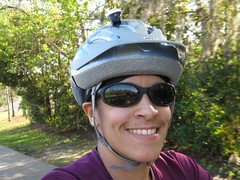
self portrait Bike commuting, wether to work or to the market, is a great way to go green because it is a win-win for all: you get some exercise while enjoying some fresh air and saving money on gas, and you help ease congestion and reduce pollution by having one less car on the road. I also find that I am much more productive at work in the mornings when I bike commute. It's probably all those endorphins from the exercise.

When we lived closer to UCF, we biked to work 3-4 times a week. Now our ride is 14.5 miles each way, so we only ride 1-2 days a week. I would love to ride more often, but time is the biggest limiting factor since it takes twice as long to ride our bikes than to drive there. This would not be such a problem since I get up by 6 am to exercise most days anyway (I can actually sleep in a tad on days when we bike to work), but if I spend all my time biking to and from work, when will I run and swim? We're going to try biking every day one week and see how it goes, but I don't think I'll have the time or energy to sustain that in the long run unless I gave up running -- yeah, that's NOT happening =P

Resources
So what are you waiting for? Give bike commuting a try! If you already do, tell us about your experience in the comments, including tips, tricks, and tools you use to make your commute easier, safer and more enjoyable.

Thursday, November 13, 2008

Running Green

This week's topic for Take It and Run Thursday at the Runner's Lounge Blog is Running Green.

I try to live a pretty green life, even though I know there is a LOT more I can do. Some of the green things I do on a regular basis include biking to work (and anywhere else I can instead of driving), bringing my own canvas bags to the grocery store/farmer's market, and using my Kleen Kanteen water bottle instead of buying bottled water. I am sure there is more, but those are the big ones.

The November 2008 Issue of Runner's World was all about running green and they now have a Green Running section on their site. I am going to use one of their articles, How to Be a Greener Runner, as the basis for this post and a sort of meme. Below is a the list of "30 things even a busy, sane person (i.e., you) can do" and how my own habits stack up (written in green and italics below the items from the article).

Get to Workouts
  • Good: Bike to all group runs and track workouts.
  • Better: Run to a local farmers' market to buy produce.
  • Best: Start all your runs from your home or office.
What I do: I drive to my long runs with the Galloway group because it is too far, and too early, to bike there. However, I make it a point to make the most of the drive and run errands in the area, such as going to the farmer's market. Most of my other runs I do around my neighborhood so I do not have to drive to run. From time to time, I will run to or from work or bike to a local park to run.

Race
  • Good: Participate in eco-conscious races (check out page 74 or go to runnersworld-greenteam.com)
  • Better: Carpool or take public transit to get to and from events.
  • Best: Race in your hometown as much as possible.
What I do: Most of my races are within 30 minutes of my home and I carpool to them with Jason. We recently ran a race at UCF, where we work, and we biked there and to brunch after. It was awesome and I wish they had more races close enough to do this more often.

Hydrate
  • Good: Buy powdered sports drinks and mix them yourself.
  • Better: Wave away plastic race cups by carrying your own water in a secure container (like Amphipod's Hydraform Handheld Pockets).
  • Best: Use reusable bottles instead of throwaway plastic water bottles.
What I do: I don't drink sport drinks, so the first does not apply. I used to carry my own water bottle when I ran, but I find that it started to hurt my shoulder as I got faster. I guess this means I need to work on my form or get a fuel belt. I hardly ever buy bottled water any more and refill my own instead, but I do grab bottled water when at races. I do try to find the recycling bin to dispose of it. Now that I think about it, I will bring the bottles home and recycle them if I can't find a recycling bin at the race.

Buy New Shoes
  • Good: If you run on trails only occasionally, buy one pair of shoes that can handle light off-road use.
  • Better: Pick shoes that are made with fewer nasty solvents and recycled components, such as the Nike Air Pegasus 25 and END's Stumptown.
  • Best: Buy the Brooks Trance 8. Its midsole is made out of BioMoGo, a material that reportedly decomposes 50 times faster than conventional midsoles.
What I do: I have no idea how environmentally friendly my shoes are. I should look into this.

Buy Apparel
  • Good: Buy shirts, outer layers, and especially socks made with merino wool, a natural and renewable resource.
  • Better: Buy clothes made from recycled postconsumer polyester, like Patagonia's Capilene 1 T-shirt. And when you're done with it, Patagonia will recycle it into other apparel.
  • Best: Hold off on new purchases and wear your existing apparel as long as you can.
What I do: I have no idea how environmentally friendly my clothes are, but I do recycle my clothes by giving them to my mom or the local thrift store. Since I just started running, I've been buying a lot of gear, but I am going to try to make do with what I have for now. I do need a few things for winter running, but after that I am done! :)

Make a Difference
  • Good: Donate to the Rails-to-Trails Conservancy, local parks boards, or other organizations that create and promote new trails or running paths.
  • Better: Volunteer to clean up a local trail, or adopt a road you like to run on.
  • Best: Organize a recycling drive at a local race where participants can bring old gear.
What I do: None of these apply, but I should look into getting more involved in making my running community more green.

Care for Your Gear
  • Good: Restore the breathability and repellency (and extend the lifespan) of your waterproof gear by washing it with McNett's ReviveX.
  • Better: Reduce your consumption of plastic and water by switching to superefficient concentrated forms of laundry detergents.
  • Best: Wash your apparel in cold water and hang dry. (Bonus: Your clothes won't pill, and they'll last longer.)
What I do: I always wash all my clothes in cold water. I do not even know when was the last time I washed anything in warm or hot water. We recently installed a clothes line in the backyard, and I am actually enjoying hanging all our laundry to dry every weekend.

Fuel Up
  • Good: Recycle energy-bar wrappers with the Energy Bar Brigade (see terracycle.net), which up-cycles them into other products. For each wrapper you save, sponsors give 2 cents to a charity you pick.
  • Better: Make your own energy bars. You can buy mixes or see page 41 for a recipe.
  • Best: Eat one less serving per week of meat, which requires significantly more fuel and water to produce than other sources of protein.
What I do: Ever since I started losing weight, I've been trying to eat less meat as well. I go through phases, but I am definitely eating way more veggies than I used to and my meat portions are a lot smaller. I need to get back to Meatless Mondays.

Cross-Train
  • Good: Run outside whenever you can (rather than inside on a treadmill).
  • Better: If you need snowshoes, a bicycle, or a set of weights, purchase gently used equipment rather than new gear. Try buying it from someone local through a resource like Craigslist.org.
  • Best: Leave your car in the driveway and bike or run to the gym once a week.
What I do: I hate the treadmill, so running outside is a given. I am in the market for a new bike and plan to check out our school's bike auction next week. I bike to work at least 4 times a week and to run errands whenever possible.

Deal with Old Shoes
  • Good: Wear them casually afterward. They may lack cushioning for a long run, but they're fine to walk the dog.
  • Better: Donate them to Nike's Reuse-A-Shoe program, which recycles the shoes to help surface new tracks and for other uses.
  • Best: Donate them to Soles4Souls, Shoe4Africa, or One World Running, outfits that give shoes to needy people. For more information, check out runnersworld.com/donate.
What I do: I just bought my 3rd pair of shoes, but still using my 2nd pair. I mainly bought these new shoes now to break in a bit and wear at my first 1/2 marathon. I am using my 1st pair to bike and other non-running activities. I am going to look into donating shoes once I start accumulating more.
Related Posts with Thumbnails